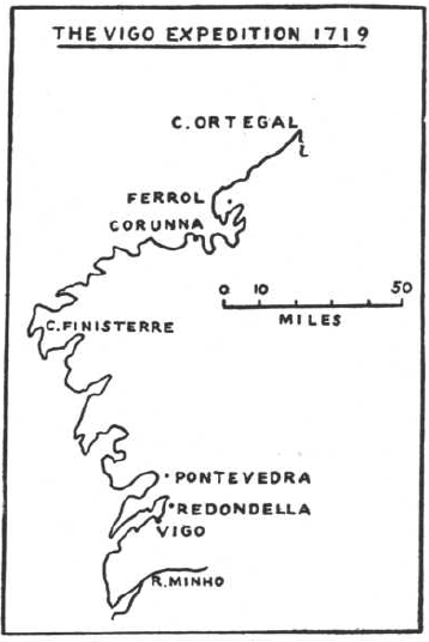
On this day in 1719, the 37th Regiment of Foot left England for Spain to engage in one of its least known actions, the capture of Vigo.
In early 1719 Spanish forces descended on Scotland in support of the Jacobite rising. Five thousand troops had been sent by Spain to fight against the Quadruple Alliance of Britain, France, Austria, and Savoy, although most of the Spanish force had been dispersed by storms on the way. The Spanish were defeated but nonetheless, Spanish intervention was intolerable and a punitive expedition was assembled.
A force of six thousand British troops, including the 37th Regiment of Foot, was dispatched with a strong escort of four ships of the line and three frigates. The expedition targeted the vulnerable Spanish coast and coincided with a French offensive in eastern Spain.
The expedition left Falmouth on the 21st of September and arrived off Vigo on the 29th. Among the first to land were the grenadiers of the 37th who, together with the Guards and other grenadiers, swept the beach clear ahead of the main landing. Resistance was slight as the Spanish could not garrison their entire coast and the people of Vigo evacuated all that they could in advance of the British force. The town was just three miles from the landing beach and it was taken early on the 1st of October. The Spanish garrison in the area – eleven companies of regular troops from two Regiments – withdrew to the fortresses of San Sebastian and Fort Castro.
The Spanish expected a long and drawn-out siege; however, a surprise British attack on the evening of the 1st October shocked the defenders of San Sebastian into spiking their guns to make them unusable and retreating to the main citadel of Fort Castro. This fort proved a tougher obstacle, and more than forty mortars and siege cannon were landed to pummel the defenders into submission. On the 10th the Spanish surrendered, having suffered hundreds of casualties.
The Expedition would continue to harass several other towns, with some sharp actions fought with scattered bands of Spanish troops and local townsfolk, before heading home in November. Casualties were light, with the Regimental History noting that ‘those that fell by the vine’ outnumbered those killed in action.
In all seven merchant ships, a hundred cannon (mostly spiked), eight thousand muskets and large quantities of wine and gunpowder were seized and brought back to England. One source alleges that the materials were gathered ready for another attempted invasion. The Expedition had achieved its goal as King Charles V of Spain recognised the vulnerability of Spain and agreed to the demands made by the Quadruple Alliance in January 1720.
Museum Assistant – Chris Waters

