Among the many awards won by the Regiment during the Second World War, Private Paul Lombardi’s Mention in Despatches stands out as one of the Regiment’s most daring escapes since Captain Harris’s 450-mile escape in the First World War.
Born in 1915, Pte Lombardi joined the Hampshire Regiment in the dark days of June 1940 after the fall of France. Assigned to the 5th Battalion, he was sent to Tunisia in 1943 and was one of the 2300 Allied prisoners taken during the Battle of Sidi Nsir in February 1943 when the 5th Battalion and 155 Battery Royal Artillery were overrun after a fierce battle that held up a German offensive.
Paul was transferred to Italian custody and moved to Camp 82 in Laternia, Italy. On the 8th of September 1943, an armistice between Italy and the Allies came into effect and the plight of Allied prisoners in Italian custody was recognised by clause three of the Armistice with the following statement: “All prisoners or internees of the United Nations to be immediately turned over to the Allied Commander in Chief, and none of these may now or at any time be evacuated to Germany.” In practice, however, there was nobody to hand over the prisoners; as most Italian guards simply deserted now that they were no longer engaged in the war – many fleeing the retaliation of German troops whilst Allied troops had only just begun landing in Italy.
Following the chaos at the end of the First World War when many Allied prisoners of war had left German POW camps only to starve or suffer chaotic journeys attempting to get home, it had been decided to order men to remain in place until relieved by Allied troops. Whilst thousands of men decided to make their own way home contrary to official guidance, many remained in camps and quickly found themselves back under guard as German troops swept into the country.
Paul was one of the thousands of Allied prisoners loaded onto trains towards Germany. On Paul’s train alone, more than 2500 prisoners were stuffed aboard. Paul and another man – Company Sergeant Major Lawson of the Union Defence Force in South Africa took the opportunity to jump off the train before it picked up speed and disappeared into the woods of Tuscany.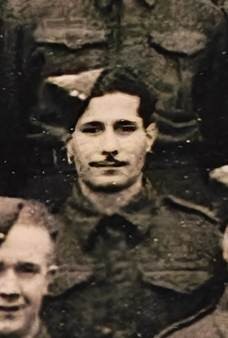
The pair walked roughly seven miles from Laterina to a farmhouse near Levane where the pair must have sought aid from the inhabitants. The mood in Italy had shifted and many Italians were keen to aid the Allies against the Germans, who had implemented a harsh occupation on their former comrades. Paul and Lawson would remain at the farmhouse for twelve days until they decided to travel south to Allied lines.
After an 18-mile walk, the pair reached the mountain town of Monte San Savino; what followed was a 230-mile odyssey to Castel Di Sangro, passing through L’ Aquila on the way. Lombardi’s report features numerous mentions of rivers and lakes and the pair must have used the waterways to navigate, drink and perhaps even fish to survive. A further journey of 20 miles brought Lombardi and Lawson to Pesculanciano just a short distance from the frontline and on the 27th of October 1943 the pair encountered Canadian troops.
Over 40 days and more than 300 miles, Lombardi had managed to evade the Germans and escape; for his efforts, he was Mentioned in Despatches. Once in Allied hands, he was relayed all the way to the port of Taranto and back to the UK. Lombardi would continue to serve with the Regiment until May 1946.
Pictured is Lombardi and an excerpt of his escape report; many liberated prisoners completed an interview to collect as much information on the whereabouts of camps, conditions (including any war crimes witnessed), number of prisoners and any potential aid that could be rendered to prisoners or reports of attempted escapes.
By Chris Waters – Museum Assistant

