On this day in 1944, the 1st Battalion and the rest of 231 Brigade launched an attack on the town of Hottot in Normandy. Lieutenant Blackmore commanded 7 Platoon, A Company and detailed his platoon’s fight to clear its first objective during the battle. His account provides a snapshot of the challenges and nature of fighting in Normandy.
At 7:07 am, A Company of the 1st Battalion advanced south from Ferme De Braijere with No.8 Platoon on the left, assigned to clear a cornfield, whilst No.7 on the right was assigned to clear an orchard. No.9 Platoon was held in reserve and provided covering fire for the advance.
A hedgerow preceded the cornfield and Orchard, and it was here that the advance came under concentrated fire from a machine gun positioned to the south-east corner of the Orchard (marked MG1 on the map); it was quickly suppressed by the fire of No. 7 and No.8 platoons.
No.7 Platoon the began to advance up the left-hand side of the orchard when it was struck by several booby traps – these were remotely detonated by command wires that stretched back to German lines; miraculously, no casualties were sustained from the traps.
When the leading section of No.7 platoon reached the south-east corner where MG1 had been sited, three German machine guns in the south-west corner of the orchard and a section of German infantry dug in on the east side of the field opened fire.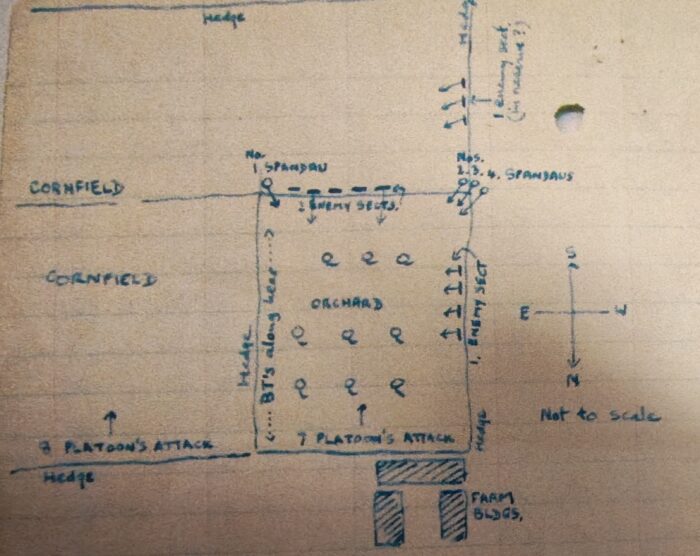
What could well have turned into a disaster was averted by the bravery of Private Robins, who single-handedly charged the machine gun position. Firing his Bren gun from the hip, Robins killed the German NCO commanding the MGs and pinned the surviving gunners down.
Robins’ actions allowed two sections to spring forward whilst the third suppressed the Germans on the east. The German positions were burnt out by No.77 phosphorus grenades and then stormed at the point of the bayonet.
In the first 15 minutes of the attack, No.7 Platoon had achieved its first objectives, suffering two men killed and one man wounded. 7 Germans had been killed and 13 captured. Private Robins won the Military Medal for his actions. The attack on the 11th of July saw the northern reaches of Hottot reached, but the 1st Battalion was ordered to withdraw due to German counterattacks. Hottot was not taken until the 18th of July when the Germans abandoned the town.
Booby traps, mines and prepared German defences and camouflaged machine gun nests would challenge the Allied advance in Normandy, where every hedgerow provided a ready defensive position. Only a slow, methodical advance could clear the hedgerows with the utmost courage required to press the attack home. Whilst the infantry made up 1/5th of the British Army’s strength in Normandy, they suffered 4/5ths of the casualties, with losses 80% above those projected.
Chris Waters – Museum Assistant
Images –
Right – not to scale map of the area
Main image – The area taken in 2009; the right corner of the hedgerow was where the three German machine guns were located.
The Battle of the Somme – 110 years onOn this day 110 years ago, the Battle of the Somme began. Preceded by 7 days of artillery bombardment, the British Army went over the top at 7:30 am on the 1st of July 1916 and suffered 60,000 casualties by the end of the day, equating to two casualties for every yard of the front attacked. The 1st Battalion of the Hampshire Regiment alone suffered 589 casualties in its attack in the Beaumont Hamel area, more than half the battalion.
Whilst the first day of the battle understandably dominates popular memory, fighting would continue until November, with more than a million casualties in total from just this battle. Despite disastrous casualties in the north on the 1st of July, British and French forces broke through the first German line in the south and the battle would continue from there.
The 1st, 2nd, 11th, 14th and 15th Battalions of the Hampshire Regiment would fight during the battle which would prove a trial by fire for the ‘New Army’ units raised from the enthusiastic volunteers of 1914 and 1915. Whilst the 11th, 14th and 15th Battalions all had experience of trench warfare since arriving in France; it would prove to be their first major offensive battle and despite heavy losses, the ‘New Army’ Battalions would acquit themselves well. The 15th Battalion famously served alongside the first tanks at Flers-Courcelette on the 15th of September 1916 and succeeded in taking its objectives.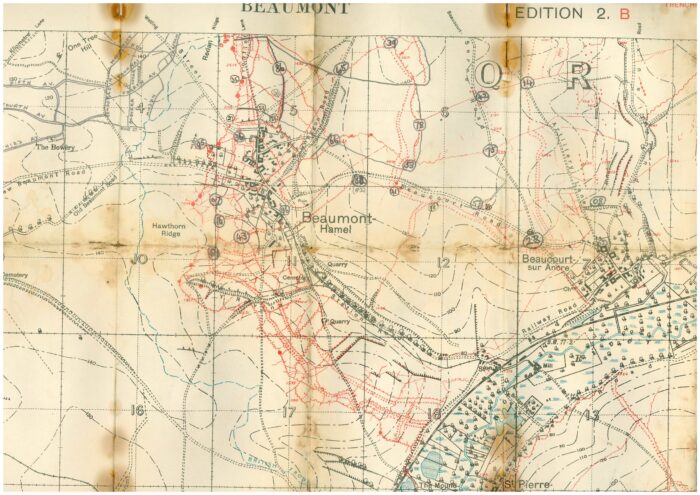
Throughout the battle, the British Army was gradually learning and evolving, incorporating new ideas and technology, though often at a heavy cost. It is worth remembering that the British Expeditionary Force deployed to France in 1914 consisted of just 150,000 men, whilst 2 years later, the British Army deployed 1.2 million men during the Battle of the Somme.
The Battle had a marked effect on the German Army, with one German officer describing the Somme as ‘the muddy grave of the German Army’. On the 11th of July, the German Army suspended its offensive against Verdun, giving the French Army much-needed respite, and after the battle, the Germans would withdraw 25 miles to the Hindenburg line, yielding more ground to the Allies than had been won since 1914.
Today we remember all those who were killed, injured or taken prisoner during the Battle.
Image (right) Trench map from later in the conflict (1916)
Cover image courtesy of the Imperial War Museum Q3978.
Chris Waters – Museum Assistant
Behaved with the greatest gallantry – commemorating Messines Ridge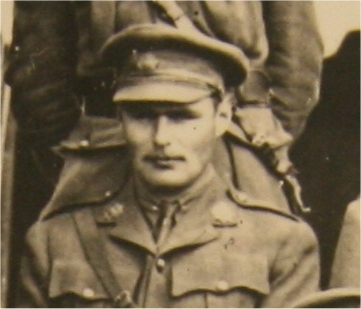
Second Lieutenant Francis John Whaley
On this day in 1917, the 15th Battalion took part in the capture of Messines Ridge in Belgium. Messines Ridge to the South of Ypres offered the Germans a clear view of the Allied lines in the Ypres salient and as the main British offensive of 1917 was planned to be launched from the salient in July, the capture of the ridge was vital.
The 9 attacking Divisions were supported by 2,230 guns firing a barrage of 3.5 million shells; also in support were the Royal Flying Corps and new and reliable Mk IV tanks. 19 mines dug under the German trenches were detonated simultaneously in the largest and deadliest man-made explosion until the use of the Atomic bomb.
The 15th Battalion was in the reserve Brigade of the 41st Division and advanced as planned after the capture of the German front line. The strong points of Oblong Trench, Englebrier Farm, Ravine, and Denys Wood were rapidly captured, and by 9 am the 15th Battalion had consolidated on its final objective. 2nd Lieutenant Whaley and Regimental Sergeant Major Greenwood were both awarded Military Crosses for capturing large numbers of prisoners (Greenwood with just one man in support captured 20, whilst Whaley braved artillery fire to pursue fleeing Germans).
The Germans began to counterattack; but their plans had relied on the ridge being held until the two Engrief (counter-attack) divisions arrived and their efforts were blunted by British troops who were ready and waiting to meet them. The 15th Battalion repulsed a first attack by 500 Germans at 10 am and had just defeated a second effort at 3 pm when the 24th Division swept through to capture the final Oosttaverne line.
Success had been complete and all objectives across the line had been taken. Estimates vary, but both sides suffered more than 20,000 casualties, with only a little difference between the losses of the attackers and defenders – a rare achievement during the First World War.
The 15th Battalion suffered 43 killed or missing and 141 wounded during the capture of Messines Ridge.
A notebook belonging to Whaley’s commander in the museum’s collection contains the original recommendation for 2nd Lieutenant Whaley’s Military Cross.

