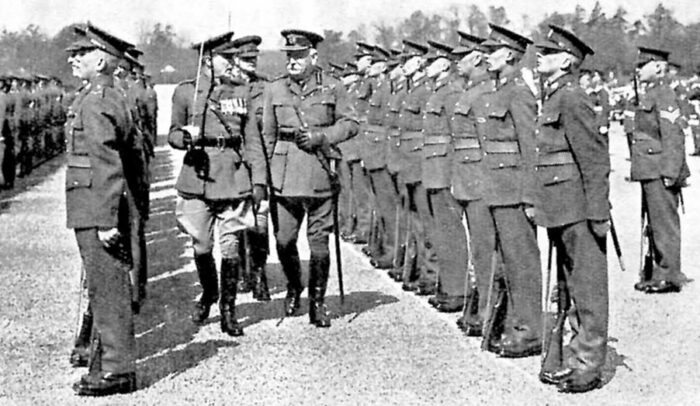
This picture shows the men of the 2nd Battalion being inspected by General Haking KCB KCMG on Gallipoli Day, 1939. His next visit to the Battalion was on the 2nd of September 1939, a day before the declaration of war.
On the 3rd of September 1939, the United Kingdom declared war on Nazi Germany. The declaration of war was heeded around the world.
Tensions had been building for months before the declaration. The previous year the Munich agreement and resulting surrender of the Sudetenland to Germany in September 1938 had promised ‘peace in our time’ and an end to German territorial ambitions; however, in March 1939 Germany seized the rest of Czechoslovakia, took Memel from Lithuania and demanded Danzig (modern Gdansk) from Poland – it was clear that peace was not going to last for long.
In May 1939 the Military Training Act saw men between the ages of 20 and 21 called up for six months of training before joining the Army reserve – the first instance of peacetime conscription in the United Kingdom’s history – and renewed efforts were made to arm and train the Army with spending doubling from 39.7 million pounds in 1935 to 85.7 million pounds in 1939.
As in every year in the Army, August was the time for summer camps and training, although the 2nd Battalion had little luck whilst the ‘clouds of war’ gathered over Europe; real clouds gathered over Holt End Camp where the 2nd Battalion were training and reduced the training area to a morass. The men were given 5 days leave and training continued in barracks until the ground had dried – just as abruptly as the men had left barracks, on the 24th of August 1939 they were recalled.
Full mobilisation was not ordered but certain steps, including the end of leave, were taken across the British Army. Unbeknownst to the men of the 2nd Battalion; events were rapidly escalating. Hitler delayed his invasion of Poland after guarantees from Mussolini faltered – so sudden was his decision that one German infiltration unit did not receive the message and attacked a Polish railway station in the early hours of the 26th of August.
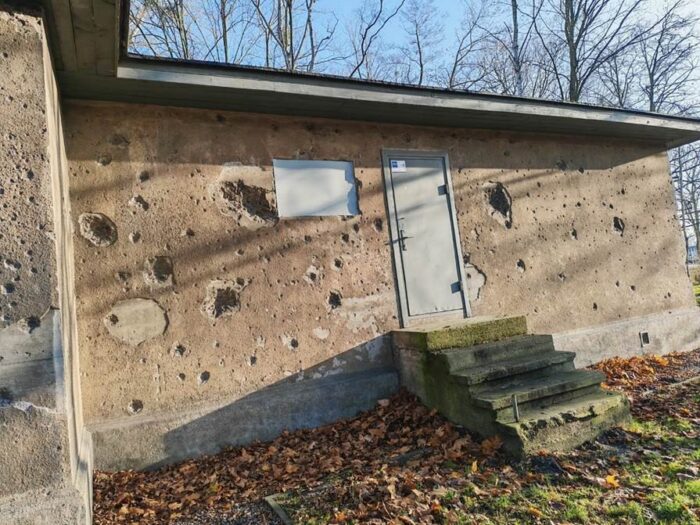
This Polish bunker on the West Platte was among the first to come under German fire on the 1st of September 1939; the damage can still be seen.
At 4:45 am local time on the 1st of September 1939, the German battleship Schleswig-Holstein fired on the Polish West Platte Fort – the first official shots of the Second World War. The reverberations reached the 2nd Battalion at 4 pm when a phone call from the 1st Guards Brigade ordered the Battalion to mobilise. At 7 pm orders were issued for a complete blackout to avert the risk of air attack and by 9 pm the Battalion requested 200 reservists from the Depot to make up its numbers.
On the September 2nd the Battalion was visited by General Haking KCB KCMG and various men were detached to training units as instructors (they would be sorely needed as full conscription for all men aged 18-41 would be introduced the following day) and the recruit company of the Battalion was detached.
At 1:50 pm on the 3rd of September 1939 the 2nd Battalion was informed that war had been declared between Britain and Germany; some men may have heard Neville Chamberlain’s declaration of war on the radio at 11 am after no reply had been recieved to Britain’s demand that German troops withdraw from Poland. At 2:10 pm the Battalion tested its respirators – the blackout and respirator check indicating the horrors of aerial bombardment and advanced chemical weapons expected at any moment from the new war.
At 2:20 am the 200 reservists requested from the depot arrived, bringing the Battalion up to war strength. Just 11 days later, the Battalion’s advanced guard was embarked in Southampton to join the British Expeditionary Force in France.
Around the world in Egypt, the 1st Battalion of the Hampshire Regiment received a simple message on the 4th of September: “mobilize, all regular troops under your command are to be regarded as on active service from today’s date.”
Lest we forget.
Chris Waters – Museum Assistant

