On this day in 1917, 2nd Lieutenant Dennis GW Hewitt of the 14th Battalion of the Hampshire Regiment won the Victoria Cross.
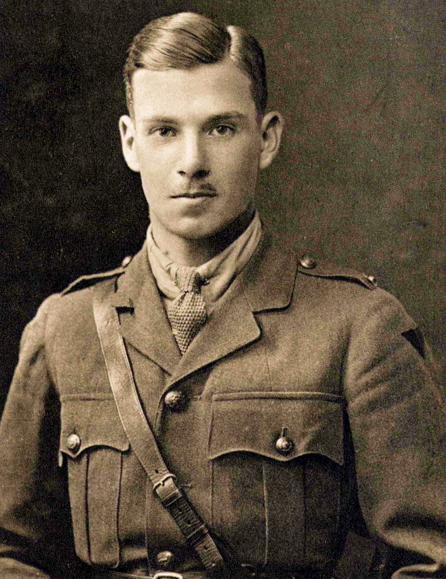
2nd Lieutenant Dennis GW Hewitt of the 14th Battalion of the Hampshire Regiment
The 31st of July 1917 marked the start of the Third Battle of Ypres, also known as the Battle of Passchendaele. The area was seen to offer the best chance for a decisive breakout as an advance from the Ypres salient could overrun the key railroad hub of Roeselare and even put German submarine bases on the Belgian coast under threat.
Ypres was surrounded to the north, east, and south by the Germans and was under constant observation and fire. The capture of Messines Ridge in June 1917 had removed the Germans from their most dominating positions in the south, enabling the build-up of the main offensive. Two weeks of bombardment (of more than 4.2 million shells) preceded the main attack on the 31st of July 1917.
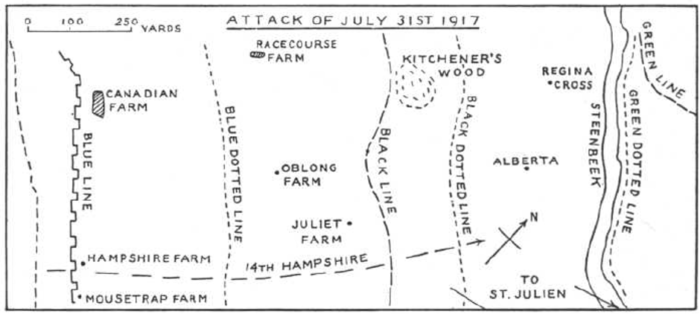
The 14th Battalion was part of the 39th Division, which was committed to the opening attack at 3:50 am on the 31st of July 1917. The 14th Battalion was held in reserve until the first line (blue – see map below) was taken by the 11th Royal Sussex. Leapfrogging the Sussex’s advance, the 14th Battalion took its first objective without much difficulty. The plan of attack was complex, with a creeping barrage preceding the advance by 90 meters, moving forward every 4 minutes.
19-year-old Second Lieutenant Dennis Hewitt was one of the men waiting for the barrage to advance; he had left his studies at Winchester College for Sandhurst in 1915 and had served with the 14th Battalion of the Hampshire Regiment in the later stages of the Battle of the Somme the previous year.
Hewitt was waiting for the barrage to lift when a piece of shrapnel struck his haversack, setting the signal lights inside alight. Hewitt managed to extinguish himself but had been badly burnt. Despite his injuries, Hewitt continued to lead his Company on to the next objective and through heavy machine-gun fire, ensured that the ‘Black dotted line’ was taken. Hewitt was leading the consolidation of the position when he was killed by a sniper. His leadership in the face of fierce opposition despite his severe wounds earned him the Victoria Cross.
The 14th Battalion continued to advance, reaching the green dotted line before 118 Brigade took over the attack on the final green line. 63 Officers and men of the Battalion were killed or missing and 161 wounded; however, the Battalion had achieved its objectives and captured more than 200 prisoners as well as 17 machine guns.
The attack on the 31st of July had proved to be a success with significant gains made across much of the Allied line. Unfortunately, heavy rain swept in, cutting off observation of the foremost troops; the Green Line was thus abandoned as artillery could not be directed against German counterattacks. With much of the churned-up battlefield reduced to mud by the rain, the offensive could not resume until the ground had dried out, giving the Germans time to reinforce the area.
The Third Battle of Ypres would continue to rage until November 1917, with a total of more than 500,000 casualties on both sides; no breakthrough would be achieved.