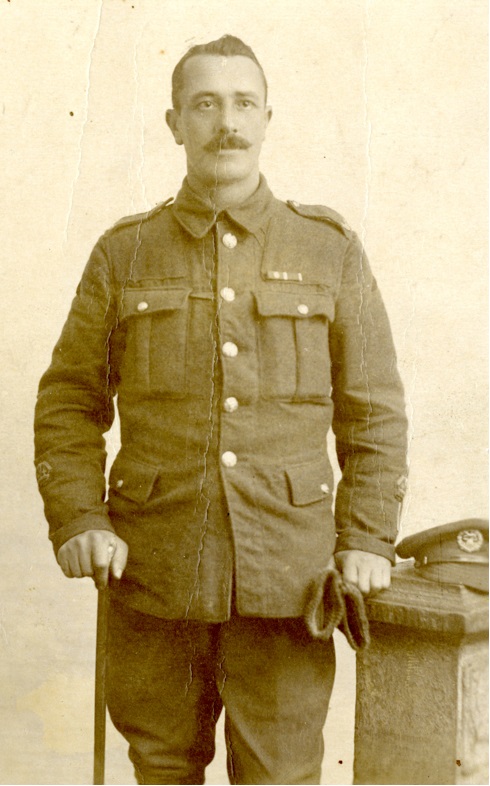
 Thrice decorated, wounded and promoted from the ranks, Captain Joseph Milne was one of the only men of the 2nd Battalion to serve from their first day of action at Gallipoli on the 25th April 1915, through to the end of the war on the 11th of November 1918.
Born in Edinburgh in 1881, the Milne family later moved to the Isle of Wight. In 1899, at the age of 18, Joseph enlisted in the Hampshire Regiment. He served with the 1st Battalion in Aden and Somaliland before transferring to the Regimental Depot and a few years later, to the 2nd Battalion in Mauritius. Joseph steadily advanced up the ranks and on the outbreak of the First World War was a Sergeant.
Joseph fought throughout the Gallipoli campaign and was wounded by shrapnel during the 2nd Battle of Krithia. He was awarded a Distinguished Conduct Medal for consistently leading his Platoon with the utmost gallantry throughout the early stages of the campaign. He was probably evacuated to England to recover from his wounds as he briefly served with the 3rd Battalion which was home-based and his DCM was personally presented to him by Lord French (former commander of the British Expeditionary Force).
Joseph soon returned to active service with the 2nd Battalion and won a Bar to his DCM whilst serving as a Company Sergeant Major during the battle of Cambrai by “going out on his own initiative with a patrol and working his way up to a machine gun that was causing casualties, opening fire on the gunners, and succeeding in driving them back”.
Joseph was commissioned as a Second Lieutenant in June 1918 where he would lead a Platoon of Y Company, 2nd Battalion for the remainder of the war.
On the 17th of October 1918, the 9th Division held a precarious bridgehead over the Lys River; German artillery fire smashed the bridges supplying the lodgement and scant supplies were being dropped by air to the beleaguered troops. The famous Brigadier General Freyberg VC GCMG KCB KBE DOSO with three bars KStJ (then commanding the 88th Brigade) personally crossed into the bridgehead and decided to evacuate the position. The 2nd Battalion provided Lewis gun teams to cover the withdrawal and in the dark of night, the 9th Division men were evacuated. Joseph, accompanied by Freyburg, commanded the last party to recross the Lys, and was awarded the Military Cross for his leadership in the action which proved to be one of the last for the 2nd Battalion in the War.
Joseph led his platoon across the German border on the 5th of December 1918. In recognition of his service, he was selected as part of the guard that returned to England to retrieve the Battalion’s colours from Winchester Cathedral.
Joseph continued to serve with the 2nd Battalion in Russia in 1919 and Ireland in 1920; he left the Army in 1922.
This photograph was taken of Milne when he was a sergeant; some of his effects, including his Commissioning Parchment and Military Cross citation, are held in the museum’s collection.
Chris Waters – Museum Assistant
The Battle of the Somme – 110 years onOn this day 110 years ago, the Battle of the Somme began. Preceded by 7 days of artillery bombardment, the British Army went over the top at 7:30 am on the 1st of July 1916 and suffered 60,000 casualties by the end of the day, equating to two casualties for every yard of the front attacked. The 1st Battalion of the Hampshire Regiment alone suffered 589 casualties in its attack in the Beaumont Hamel area, more than half the battalion.
Whilst the first day of the battle understandably dominates popular memory, fighting would continue until November, with more than a million casualties in total from just this battle. Despite disastrous casualties in the north on the 1st of July, British and French forces broke through the first German line in the south and the battle would continue from there.
The 1st, 2nd, 11th, 14th and 15th Battalions of the Hampshire Regiment would fight during the battle which would prove a trial by fire for the ‘New Army’ units raised from the enthusiastic volunteers of 1914 and 1915. Whilst the 11th, 14th and 15th Battalions all had experience of trench warfare since arriving in France; it would prove to be their first major offensive battle and despite heavy losses, the ‘New Army’ Battalions would acquit themselves well. The 15th Battalion famously served alongside the first tanks at Flers-Courcelette on the 15th of September 1916 and succeeded in taking its objectives.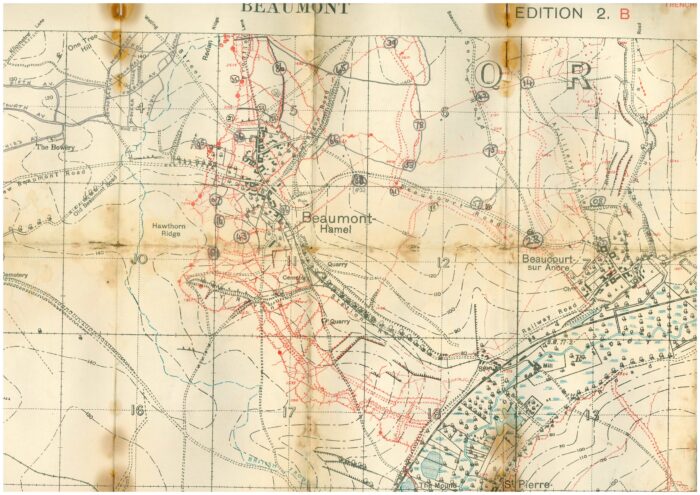
Throughout the battle, the British Army was gradually learning and evolving, incorporating new ideas and technology, though often at a heavy cost. It is worth remembering that the British Expeditionary Force deployed to France in 1914 consisted of just 150,000 men, whilst 2 years later, the British Army deployed 1.2 million men during the Battle of the Somme.
The Battle had a marked effect on the German Army, with one German officer describing the Somme as ‘the muddy grave of the German Army’. On the 11th of July, the German Army suspended its offensive against Verdun, giving the French Army much-needed respite, and after the battle, the Germans would withdraw 25 miles to the Hindenburg line, yielding more ground to the Allies than had been won since 1914.
Today we remember all those who were killed, injured or taken prisoner during the Battle.
Image (right) Trench map from later in the conflict (1916)
Cover image courtesy of the Imperial War Museum Q3978.
Chris Waters – Museum Assistant
Behaved with the greatest gallantry – commemorating Messines Ridge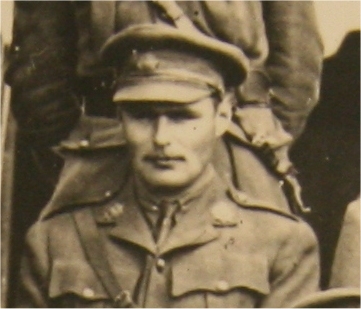
Second Lieutenant Francis John Whaley
On this day in 1917, the 15th Battalion took part in the capture of Messines Ridge in Belgium. Messines Ridge to the South of Ypres offered the Germans a clear view of the Allied lines in the Ypres salient and as the main British offensive of 1917 was planned to be launched from the salient in July, the capture of the ridge was vital.
The 9 attacking Divisions were supported by 2,230 guns firing a barrage of 3.5 million shells; also in support were the Royal Flying Corps and new and reliable Mk IV tanks. 19 mines dug under the German trenches were detonated simultaneously in the largest and deadliest man-made explosion until the use of the Atomic bomb.
The 15th Battalion was in the reserve Brigade of the 41st Division and advanced as planned after the capture of the German front line. The strong points of Oblong Trench, Englebrier Farm, Ravine, and Denys Wood were rapidly captured, and by 9 am the 15th Battalion had consolidated on its final objective. 2nd Lieutenant Whaley and Regimental Sergeant Major Greenwood were both awarded Military Crosses for capturing large numbers of prisoners (Greenwood with just one man in support captured 20, whilst Whaley braved artillery fire to pursue fleeing Germans).
The Germans began to counterattack; but their plans had relied on the ridge being held until the two Engrief (counter-attack) divisions arrived and their efforts were blunted by British troops who were ready and waiting to meet them. The 15th Battalion repulsed a first attack by 500 Germans at 10 am and had just defeated a second effort at 3 pm when the 24th Division swept through to capture the final Oosttaverne line.
Success had been complete and all objectives across the line had been taken. Estimates vary, but both sides suffered more than 20,000 casualties, with only a little difference between the losses of the attackers and defenders – a rare achievement during the First World War.
The 15th Battalion suffered 43 killed or missing and 141 wounded during the capture of Messines Ridge.
A notebook belonging to Whaley’s commander in the museum’s collection contains the original recommendation for 2nd Lieutenant Whaley’s Military Cross.

