On this day in 1944, the 1st Battalion and the rest of 231 Brigade launched an attack on the town of Hottot in Normandy. Lieutenant Blackmore commanded 7 Platoon, A Company and detailed his platoon’s fight to clear its first objective during the battle. His account provides a snapshot of the challenges and nature of fighting in Normandy.
At 7:07 am, A Company of the 1st Battalion advanced south from Ferme De Braijere with No.8 Platoon on the left, assigned to clear a cornfield, whilst No.7 on the right was assigned to clear an orchard. No.9 Platoon was held in reserve and provided covering fire for the advance.
A hedgerow preceded the cornfield and Orchard, and it was here that the advance came under concentrated fire from a machine gun positioned to the south-east corner of the Orchard (marked MG1 on the map); it was quickly suppressed by the fire of No. 7 and No.8 platoons.
No.7 Platoon the began to advance up the left-hand side of the orchard when it was struck by several booby traps – these were remotely detonated by command wires that stretched back to German lines; miraculously, no casualties were sustained from the traps.
When the leading section of No.7 platoon reached the south-east corner where MG1 had been sited, three German machine guns in the south-west corner of the orchard and a section of German infantry dug in on the east side of the field opened fire.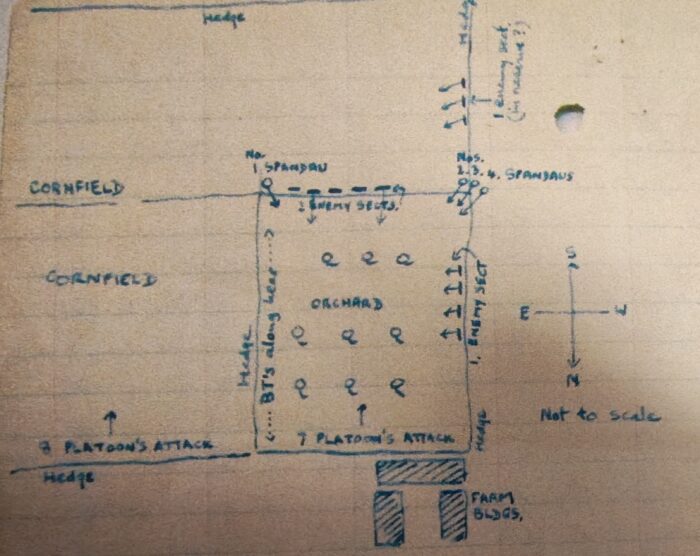
What could well have turned into a disaster was averted by the bravery of Private Robins, who single-handedly charged the machine gun position. Firing his Bren gun from the hip, Robins killed the German NCO commanding the MGs and pinned the surviving gunners down.
Robins’ actions allowed two sections to spring forward whilst the third suppressed the Germans on the east. The German positions were burnt out by No.77 phosphorus grenades and then stormed at the point of the bayonet.
In the first 15 minutes of the attack, No.7 Platoon had achieved its first objectives, suffering two men killed and one man wounded. 7 Germans had been killed and 13 captured. Private Robins won the Military Medal for his actions. The attack on the 11th of July saw the northern reaches of Hottot reached, but the 1st Battalion was ordered to withdraw due to German counterattacks. Hottot was not taken until the 18th of July when the Germans abandoned the town.
Booby traps, mines and prepared German defences and camouflaged machine gun nests would challenge the Allied advance in Normandy, where every hedgerow provided a ready defensive position. Only a slow, methodical advance could clear the hedgerows with the utmost courage required to press the attack home. Whilst the infantry made up 1/5th of the British Army’s strength in Normandy, they suffered 4/5ths of the casualties, with losses 80% above those projected.
Chris Waters – Museum Assistant
Images –
Right – not to scale map of the area
Main image – The area taken in 2009; the right corner of the hedgerow was where the three German machine guns were located.

