On this day 110 years ago, the Battle of the Somme began. Preceded by 7 days of artillery bombardment, the British Army went over the top at 7:30 am on the 1st of July 1916 and suffered 60,000 casualties by the end of the day, equating to two casualties for every yard of the front attacked. The 1st Battalion of the Hampshire Regiment alone suffered 589 casualties in its attack in the Beaumont Hamel area, more than half the battalion.
Whilst the first day of the battle understandably dominates popular memory, fighting would continue until November, with more than a million casualties in total from just this battle. Despite disastrous casualties in the north on the 1st of July, British and French forces broke through the first German line in the south and the battle would continue from there.
The 1st, 2nd, 11th, 14th and 15th Battalions of the Hampshire Regiment would fight during the battle which would prove a trial by fire for the ‘New Army’ units raised from the enthusiastic volunteers of 1914 and 1915. Whilst the 11th, 14th and 15th Battalions all had experience of trench warfare since arriving in France; it would prove to be their first major offensive battle and despite heavy losses, the ‘New Army’ Battalions would acquit themselves well. The 15th Battalion famously served alongside the first tanks at Flers-Courcelette on the 15th of September 1916 and succeeded in taking its objectives.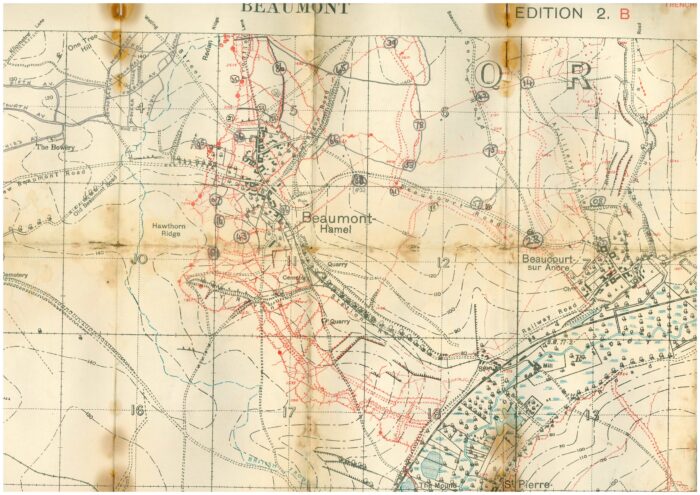
Throughout the battle, the British Army was gradually learning and evolving, incorporating new ideas and technology, though often at a heavy cost. It is worth remembering that the British Expeditionary Force deployed to France in 1914 consisted of just 150,000 men, whilst 2 years later, the British Army deployed 1.2 million men during the Battle of the Somme.
The Battle had a marked effect on the German Army, with one German officer describing the Somme as ‘the muddy grave of the German Army’. On the 11th of July, the German Army suspended its offensive against Verdun, giving the French Army much-needed respite, and after the battle, the Germans would withdraw 25 miles to the Hindenburg line, yielding more ground to the Allies than had been won since 1914.
Today we remember all those who were killed, injured or taken prisoner during the Battle.
Image (right) Trench map from later in the conflict (1916)
Cover image courtesy of the Imperial War Museum Q3978.
Chris Waters – Museum Assistant

